What Does a CFO Do? A Practical Guide for Growing Business Owners
Business owners rarely wake up one morning and decide they need a Chief Financial Officer.
Instead, they arrive there after making one expensive financial decision without enough visibility.
A hiring plan strains cash flow. A major customer delays payment and suddenly payroll becomes stressful. Revenue reaches record highs, yet there's less cash in the bank than ever before. An expansion that looked profitable on paper creates unexpected working capital demands.
These aren't accounting problems.
They're financial leadership problems.
One of the biggest misconceptions among growing businesses is that financial leadership is something you "graduate into" once revenue reaches a certain level. In reality, the need for a CFO rarely begins with company size. It begins with decision complexity.
During the early stages of a business, many financial decisions are relatively straightforward. The owner knows every customer, approves every purchase, and has a clear understanding of cash coming in and going out.
Growth changes that equation.
As revenue increases, so do payroll obligations, customer payment cycles, vendor relationships, inventory investments, financing options, and operational complexity. Suddenly, decisions that once relied on instinct require financial analysis.
That's where a CFO creates value. Not by replacing your accountant or bookkeeper, but by helping leadership understand the financial impact of today's decisions on tomorrow's business.
Understanding what a CFO does isn't about learning another executive title. It's about understanding how experienced financial leadership helps growing businesses make better decisions before small issues become expensive ones.
For many businesses, that leadership doesn't require hiring a full-time executive. Today's fractional CFO model gives growing companies access to strategic financial expertise when they need it most, without the cost of a full-time Chief Financial Officer.
A CFO Is More Than "The Finance Person"
A Chief Financial Officer (CFO) is responsible for helping leadership understand where the business is financially, where it is headed, and what decisions will create the strongest long-term results.
Unlike a bookkeeper or accountant, a CFO isn't primarily responsible for recording transactions, closing the books, or filing tax returns. Those functions are essential, but they focus on maintaining accurate financial records and ensuring compliance.
A CFO operates differently.
Their responsibility is to help business owners answer questions like:
Can we afford to hire five new employees this year?
Should we invest in new equipment or preserve cash?
Which customers are actually generating healthy profits?
How much working capital will growth require?
What happens if revenue slows over the next six months?
These aren't accounting questions.
They're strategic business decisions supported by financial insight.
One of the most common misconceptions we encounter is that businesses believe accurate financial statements automatically lead to better decisions.
They don't.
Financial statements explain what happened.
Financial leadership helps determine what should happen next.
What Does a CFO Actually Do?
Every business has unique financial priorities, but experienced CFOs generally create value in four key areas.
Turn Financial Data Into Better Decisions
Most businesses already have financial data.
The challenge isn't collecting it. It's interpreting it.
One pattern we see repeatedly is leadership teams reviewing monthly financial statements without understanding the operational story behind the numbers. Revenue may be increasing while margins quietly deteriorate. Expenses may appear stable while cash requirements continue climbing. Sales may look healthy while customer concentration risk steadily grows.
A CFO connects financial reporting to business strategy.
Rather than simply presenting reports, they identify trends, evaluate trade-offs, and help leadership understand the financial implications of important decisions before committing valuable resources.
Having financial data creates visibility.
Using financial data strategically creates better decisions.
Protect Cash Flow Before Problems Develop
Cash flow remains one of the biggest challenges for growing businesses.
Many owners assume profitability automatically creates healthy cash flow.
It doesn't.
Growing companies often experience increasing pressure on cash because hiring accelerates, inventory expands, customers negotiate longer payment terms, or capital investments occur faster than cash collections.
One of the biggest executive mistakes is focusing on revenue while underestimating future liquidity requirements.
A CFO helps prevent those surprises by building forecasting processes that answer questions before they become problems.
How much cash will growth require?
What happens if collections slow?
Can the business support another major hire?
Is financing needed before expansion begins?
Strong forecasting improves far more than cash management. It supports hiring decisions, capital planning, lender conversations, and long-term growth strategy.
Financial leadership isn't about reacting faster.
It's about seeing financial pressure before it develops.
A Common Growth Scenario
Consider a business that has grown from $800,000 to $2 million in annual revenue over three years.
On paper, everything looks positive. Sales are increasing. The team is expanding. New customers are coming in every month.
Behind the scenes, however, the business is experiencing something many owners don't anticipate. Payroll has doubled. Customers are taking longer to pay. Inventory purchases are increasing. Equipment investments are stretching available cash. Profitability appears healthy on the income statement, but available cash continues to tighten.
Without forward-looking financial planning, leadership often assumes the solution is simply "sell more." In reality, the business may need stronger cash flow forecasting, better working capital management, or changes to pricing, payment terms, or capital allocation.
This is where experienced CFO leadership changes the conversation. Instead of reacting to financial pressure after it develops, the business begins anticipating it months in advance.
Improve Profitability Instead of Simply Increasing Revenue
Revenue growth is exciting.
Profitable growth is sustainable.
Many companies become so focused on increasing sales that they overlook whether those additional sales actually improve the business.
A CFO evaluates profitability from multiple perspectives:
Customer profitability
Product and service margins
Pricing strategy
Cost structure
Operational efficiency
Capital allocation
One unexpected insight many business owners discover is that their fastest-growing customer isn't always their most profitable customer.
Likewise, cutting expenses isn't always the best path to stronger profits. Sometimes better pricing, improved operational efficiency, or reallocating resources creates far greater financial value.
A CFO helps leadership understand where profits are created, where they're quietly disappearing, and where future investments will generate the strongest return.
Support Major Business Decisions
Some financial decisions influence a business for years.
Hiring senior leadership.
Opening another location.
Launching a new product.
Purchasing equipment.
Seeking financing.
Preparing for an acquisition.
These decisions involve far more than simple cost estimates.
They affect future cash flow, profitability, debt capacity, operational flexibility, and long-term enterprise value.
An experienced CFO develops financial models, evaluates multiple scenarios, and helps leadership understand both the opportunities and the risks before making significant commitments.
The objective isn't eliminating uncertainty.
It's reducing avoidable surprises.
Why Businesses Often Wait Too Long to Bring in CFO Leadership
Many business owners assume they'll know exactly when it's time to hire a CFO.
In reality, the transition happens gradually.
Yesterday's financial processes continue to function well enough.
The monthly reports still arrive.
The accountant continues preparing accurate financial statements.
Nothing appears broken.
Meanwhile, the business becomes increasingly complex.
Hiring accelerates.
Margins fluctuate.
Cash flow becomes harder to predict.
Growth requires larger investments.
Decision-making becomes more expensive.
One of the biggest financial mistakes we see isn't poor accounting.
It's assuming yesterday's financial infrastructure can support tomorrow's business.
By the time many companies recognize they need strategic financial leadership, they're already responding to problems instead of preventing them.
A CFO changes that dynamic.
Their role is to improve decision quality before financial challenges become operational challenges.
Bookkeeper vs. Accountant vs. Controller vs. CFO
These roles complement one another, but they solve very different business problems.
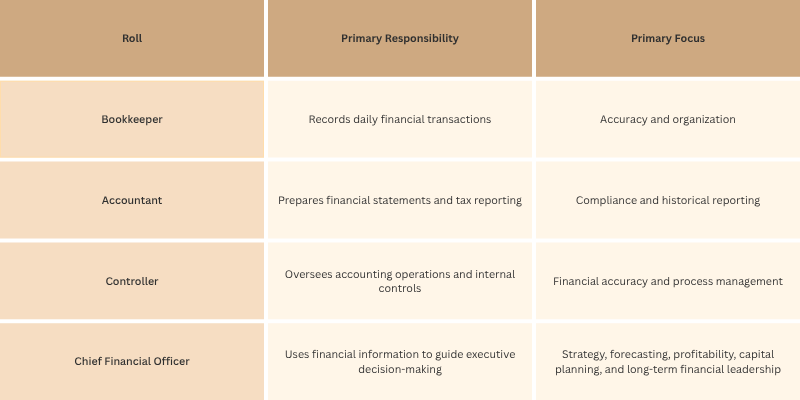
Each role is valuable.
Bookkeepers create reliable records.
Accountants ensure financial accuracy and compliance.
Controllers strengthen financial operations.
A CFO helps leadership decide where the business should go next.
That strategic perspective becomes increasingly valuable as businesses grow.
The CFO's Role Has Changed
Years ago, many CFOs were viewed primarily as financial gatekeepers. Their role centered on budgeting, compliance, financial reporting, and protecting company assets.
While those responsibilities remain important, today's CFO plays a much broader strategic role.
Modern businesses generate more financial and operational data than ever before. Accounting software, CRM systems, payroll platforms, inventory systems, and business intelligence dashboards provide an endless stream of information.
The challenge is no longer accessing data.
The challenge is knowing what matters.
Today's CFO helps leadership separate meaningful financial signals from operational noise. They translate financial information into business strategy, evaluate competing priorities, and provide decision support across every major area of the organization.
In many ways, the modern CFO has evolved from financial scorekeeper to strategic business partner.
That's especially valuable for growing companies where owners are expected to make increasingly complex decisions without adding unnecessary executive overhead.
When Is It Time to Bring in a CFO?
There isn't a universal revenue threshold.
Some companies generating $750,000 annually benefit from CFO guidance because they're growing rapidly or preparing for expansion.
Others may not need strategic financial leadership until they're several million dollars in revenue.
The real indicator isn't size.
It's complexity.
Some common signs include:
Cash flow surprises despite healthy sales
Difficulty understanding true profitability
Hiring decisions with significant financial implications
Multiple products, business units, or locations
Financing, investor, or lender conversations
Rapid growth stretching existing financial processes
Important decisions relying more on instinct than financial analysis
Some businesses discover another challenge first.
Advanced forecasting, KPI dashboards, and strategic planning depend on reliable financial information. If reporting processes, operational visibility, inventory systems, or QuickBooks data need improvement, strengthening that foundation should come first. In those situations, Mariner Consulting Group can help businesses improve reporting, inventory visibility, QuickBooks integration, and operational systems that provide the reliable financial data strategic CFO leadership depends on.
Strong financial leadership begins with strong financial information.
The Four Stages of Financial Leadership
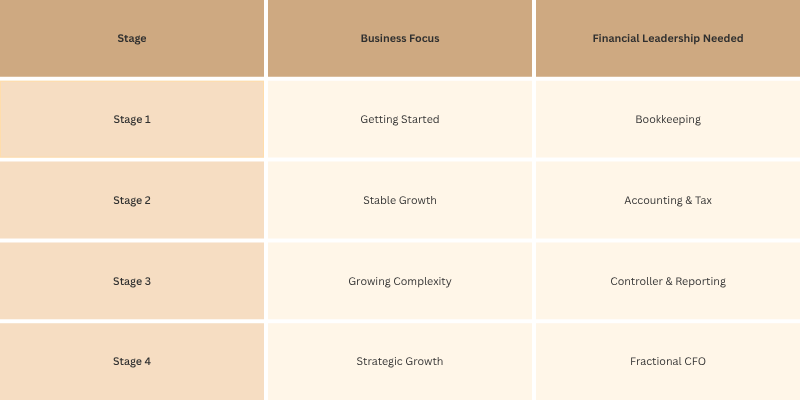
Every business moves through these stages at its own pace. The mistake many owners make is assuming they should wait until they can justify hiring a full-time CFO.
In reality, most growing companies simply need the financial leadership associated with Stage Four, not necessarily the full-time executive.
That's exactly why the fractional CFO model has become so valuable. It allows businesses to access executive-level financial guidance when complexity demands it, without taking on the cost of a permanent C-suite hire.
The Real Value of a Fractional CFO
Thirty years ago, experienced CFO leadership was largely reserved for large corporations.
Today, growing businesses can access that same strategic expertise through fractional CFO services.
A fractional CFO becomes part of your leadership team without the cost of hiring a full-time executive.
More importantly, they bring perspective developed through years of helping businesses navigate growth, uncertainty, and financial complexity.
They recognize warning signs before they become crises.
They challenge assumptions before expensive decisions are made.
They help owners move from reacting to financial results to proactively shaping them.
The strongest businesses rarely succeed because they have better financial statements.
They succeed because leadership consistently makes better financial decisions.
That's the real role of a CFO.
A CFO doesn't simply explain what happened last month. They help leadership understand what's likely to happen next, evaluate the financial consequences of today's decisions, and position the business for sustainable growth.
Whether your company is preparing for expansion, navigating uncertainty, or simply trying to gain greater confidence in its financial direction, strategic financial leadership can provide clarity that spreadsheets alone never will.
At You Need A CFO, we provide CPA/MBA-led fractional CFO services that help growing businesses improve cash flow, strengthen profitability, build reliable forecasting, and make better financial decisions with confidence.
If you're wondering whether your business has reached the point where strategic financial leadership would create meaningful value, we'd be happy to have that conversation. Schedule a free 15-minute consultation, and together we'll determine whether fractional CFO support is the right next step.